|
|
Last Modified on Jan 18, 2026
Facing a court-martial in the United States military can be a difficult, frustrating, and anxiety-inducing experience. Not only are the consequences potentially severe, but there are so many factors in courts-martial that it can be hard to know exactly what you’re up against. For anyone facing military justice, it’s important to understand some of the major distinctions in general vs. special vs. summary court-martial cases, the three main types.
A court-martial is a powerful legal tool used within the United States military. It can hold service members accountable for behavior that is prohibited, negligent, or disruptive to military operations. A court-martial is somewhat analogous to a criminal trial in civilian life, but the exact rules and processes that govern these two separate justice systems can be quite different. Even when focusing on courts-martial only, there are crucial differences between the three types of courts-martial.
Hire a Court-Martial Defense Attorney for Cases Involving Court-Martial Defense Laws
The Department of Defense’s complete court-martial manual is over 350 pages, so a comprehensive explanation of every element of courts-martial is beyond the scope of one blog post. The complexity and depth of the court-martial framework highlight the value of making the decision to hire a court-martial defense attorney early in the process. Michael J. Thompson, Attorney at Law, knows how to represent those facing any type of court-martial.
General vs. Special vs. Summary Court-Martial
Before breaking down the three major types of court-martial cases, it’s important to first explore how courts-martial differ from civilian trials. In the civilian world, court cases, whether they are criminal, civil, or regulatory in nature, are intended to pursue justice, support the public welfare, and hold violators accountable.
Military justice is different. The foremost concern is not fairness but preventing military operations from being disrupted or undermined. While both civilian trials and courts-martial can lead to similar consequences (financial penalties, time behind bars, social ostracization), these two parallel legal instruments approach the law from very different perspectives. It’s crucial to have an attorney on your side who understands this when going into your court-martial defense case.
The Three Main Types of Courts-Martial
When facing a court-martial, it’s important to know the three main classifications for court-martial cases. This enables you to better prepare for your own.
General Court-Martial
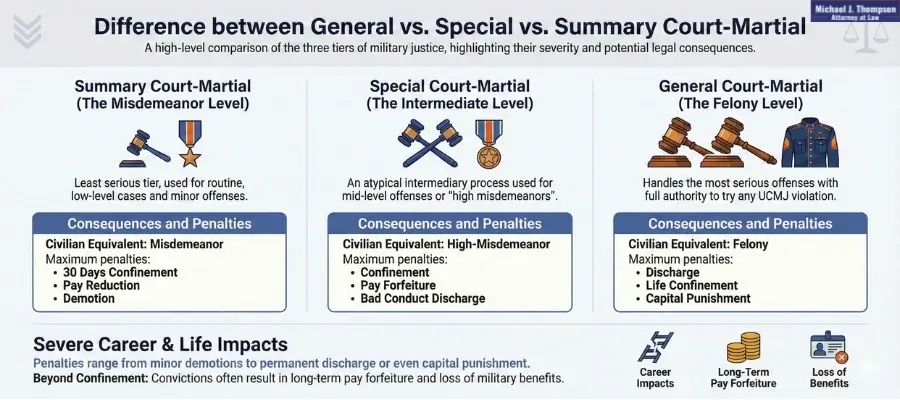
A general court-martial is a military court with the full authority to try any offenses that have been deemed punishable by the United States Uniform Code of Military Justice, or UCMJ. A general court-martial involves the most serious criminal behavior, including many actions that would be prosecuted as felonies in a civilian criminal court.
The mechanics of a general court-martial involve a panel of 5 service members, who function in a similar fashion to the jury in a civilian trial. A unanimous decision is not required in most courts-martial, however, which is another key difference between military and civilian trials. Alternatively, the accused party can request that the trial be conducted without the panel, placing themselves at the mercy of a single military judge.
The consequences for a general court-martial can be extremely severe, including not just time behind bars but also the complete loss of your military career and related benefits. Capital punishment is even a possible outcome of the most serious court-martial cases, depending on the nature of the offense and the specifics of the case.
Special Court-Martial
The use of the word “special” leads many to assume that these cases represent the most serious, complex, and high-profile scenarios. Many service members have felt a knot of dread in their stomach when they are first informed that they are facing a “special” court-martial.
In reality, the consequences and stakes at a special court-martial are typically less than those in a general court-martial. That doesn’t mean these aren’t serious legal matters, however. Confinement (imprisonment) and long-term forfeiture of pay are potential outcomes of a conviction at a special court-martial. Discharge from the military is even possible in a special court-martial, depending on the specific charges and how the court-martial case turns out.
All this confusion clears once you understand that a special court-martial is called “special” because it serves as an atypical intermediary process that falls between the general court-martial, which gets convened for the most serious cases, and the summary court-martial, which is used for less severe offenses. A special court-martial case is only “special” in the sense that it is difficult to put neatly into one of two categories, not because it is especially severe or complicated.
Summary Court-Martial
A summary court-martial is therefore the least serious type of court-martial. It is usually employed for less severe criminal acts that would be processed as misdemeanors in the civilian system.
The potential consequences for being found guilty in a summary court-martial are likewise reduced. The maximum penalty for summary cases is 30 days in lockup, a month of reduced pay, and a potential demotion in rank. A full 30-day confinement sentence and demotion for just about any offense processed at the summary level would be considered uncommon in most scenarios, however.
FAQs
What Is the Difference Between a Summary Court-Martial and a Special Court-Martial?
A summary court-martial is used for less severe offenses than a special court-martial. To put it in civilian terms, a summary court-martial is used to try misdemeanor-type offenses in a military context, while a special court-martial might be used for actions that would be considered high misdemeanors or lower-level felonies in civilian life.
What Is the Difference Between GCM and DCM?
The differences between GCM and DCM are vast, as these refer to two completely separate legal concepts that are not closely related. GCM stands for general court-martial, the most serious category of court-martial in the United States military. DCM, when used in a legal context, usually stands for differentiated case management, a courtroom management technique that is not relevant to planning your court-martial defense case.
What Is the Difference Between a Court-Martial and a Summary Hearing?
The difference between a court-martial and a summary hearing is that a court-martial is a special trial used to prosecute criminal behavior within the United States military, while a summary hearing is a legal proceeding focused on quickly resolving minor legal matters without a trial. There is a type of court-martial called “summary court-martial,” which has similarities to a civilian summary hearing, such as the focus on efficiently resolving minor matters, but it is not the same process.
What Are the Three Types of Court-Martial?
The three types of court-martial are:
- General court-martial, used to prosecute the most serious violations
- Special court-martial for mid-level offenses
- Summary court-martial, which can be used to quickly dispatch routine, low-level cases
To know what your specific type of court-martial may entail, contact a trusted attorney who can explain how the UCMJ may apply to your case.
Don’t Face Your Court-Martial Alone
In 2023, the U.S. Army processed 492 general courts-martial, 183 special cases, and 34 summary courts-martial. If you are heading into a court-martial or other type of military justice proceeding, highly qualified legal counsel is available in the Fort Campbell area and throughout Tennessee and Kentucky. Contact Michael J. Thompson, Attorney at Law, to set up a consultation and learn more about how we can help.